
Marriage: 10 Proven Tips for a Happier Relationship
A happier marriage does not happen by accident; it is built through consistent, evidence-based habits that protect emotional connection even during the most demanding parenting years.

In this article
About 40–50% of first marriages in the United States end in divorce, according to the American Psychological Association, and rates climb with each subsequent marriage. What those statistics cannot tell you is how many couples quietly drift apart not because of dramatic betrayal, but because of accumulated small neglect: skipped date nights, conversations that never go deeper than logistics, and grievances that harden into walls.
If you have children at home, the stakes feel even higher. You know your relationship shapes the emotional landscape your kids grow up in. Research published by the American Academy of Pediatrics confirms that marital conflict is one of the strongest predictors of behavioural and emotional difficulties in children, while a warm, stable parental partnership is one of the most powerful protective factors a child can have.
In this guide you will learn:
1. Protect Intentional Time Together
The single biggest predictor of marital satisfaction is the amount of positive time a couple spends together without children, screens, or task-lists competing for attention. Dr. John Gottman, co-founder of the Gottman Institute and author of four decades of marriage research, found that couples who maintain a minimum of five hours of deliberate connection each week show significantly higher satisfaction and lower divorce risk.
For parents, "date night" can feel logistically impossible, especially in the newborn months. The good news is that the quality of the time matters more than the venue. A thirty-minute after-bedtime debrief with phones face-down counts. So does a shared walk before the kids wake up.


Questions for Couples Journal: 400 Questions to Enjoy, Reflect, and Connect with Your Partner, Grow Closer & Build A Strong Partnership (Relationship Books for Couples)
- Relationships
- Image Unavailable Image not available forColor:
- ALL KINDS OF CONVERSATIONS: Discuss a variety of questions, from your favorite movies and meals to your most i
2. Master Communication Before Problems Escalate
Poor communication is the most commonly cited reason couples seek therapy, and it is almost always present in unhappy marriages long before a crisis arrives. The good news is that communication is a learnable skill, not a fixed trait.
The first principle is to speak in "I" statements rather than "you" accusations. "I felt dismissed when dinner happened without me" lands very differently from "You always ignore me." The second is to ask before assuming: most misreads in marriage come from filling in a partner's motivation without checking.
Learning active listening habits that change everything is arguably the single skill with the highest return-on-investment in a partnership. Active listening means reflecting back what your partner said before responding, which defuses defensiveness almost immediately.


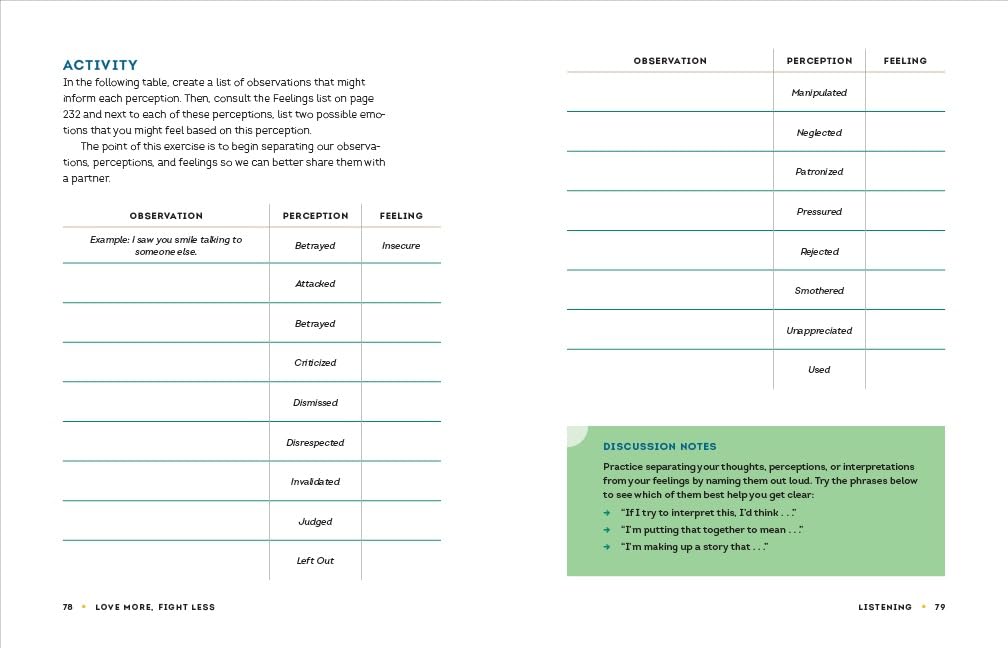
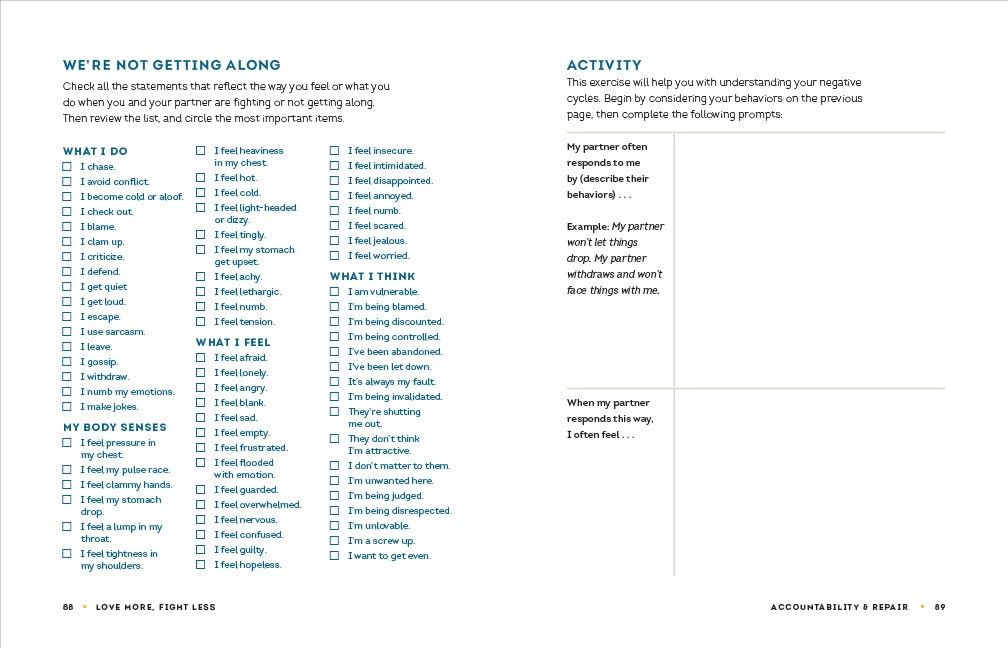
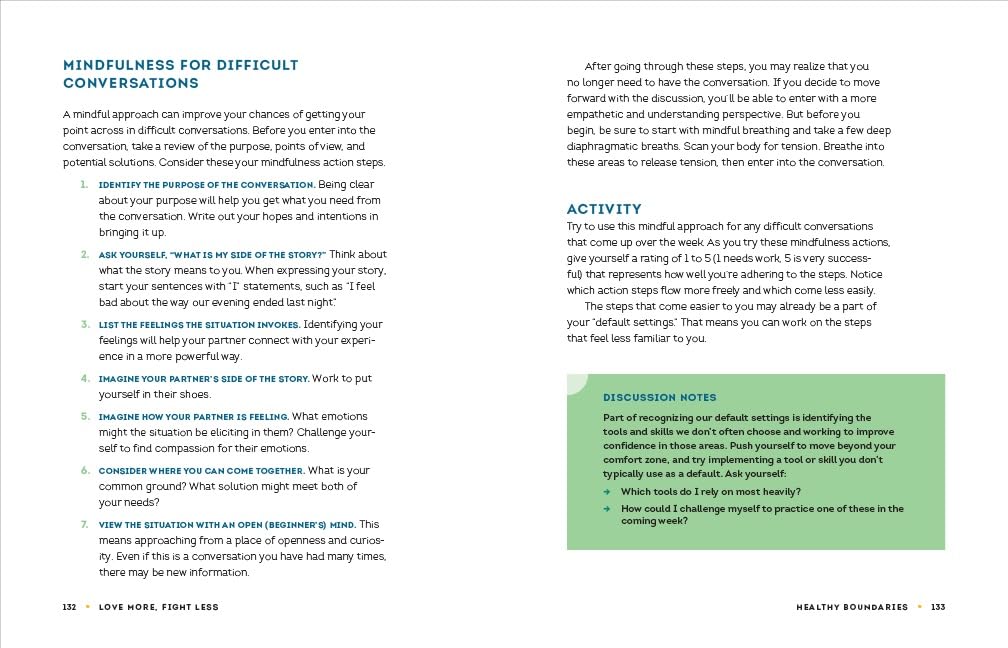
Love More, Fight Less: Communication Skills Every Couple Needs: A Relationship Workbook for Couples
- Relationships
- Image Unavailable Image not available forColor:
- 30 COMMUNICATION SKILLS AND ACTIVITIES for building self-awareness, identifying and interrupting emotional rea
3. Build a Conflict-Resolution Toolkit (Not a Conflict-Avoidance Strategy)
Conflict itself is not the enemy of a good marriage. According to research by the Gottman Institute, the presence of disagreement does not predict divorce; the presence of contempt, stonewalling, defensiveness, and criticism (what Gottman calls "The Four Horsemen") does.
The goal is not a disagreement-free home. It is a home where disagreements end in understanding rather than escalation.
The repair attempt
A repair attempt is anything you do mid-conflict to reduce tension: a light touch on the arm, an "I need to slow down," or a simple "I still love you even though we disagree right now." Couples who use repair attempts regularly show dramatically lower physiological stress responses during arguments.
Fighting fair
Fight Right: How Successful Couples Turn Conflict Into Connection
- Relationships
- Conflict Management
- Image Unavailable Image not available forColor:
4. Cultivate Mutual Respect and Daily Appreciation
Respect is not a grand gesture; it is the accumulation of hundreds of small moments. Dr. Gottman's research identified a "magic ratio" of 5:1, meaning five positive interactions for every one negative one, as the threshold that separates stable from unstable marriages.
For busy parents, that ratio can slip fast. When both partners are exhausted and stretched thin, criticism becomes the path of least resistance. Rebuilding requires deliberately noticing and naming what your partner does well.
Practical appreciation habits
Understanding what a healthy parent-child relationship actually looks like starts with the relationship your children observe between their parents every day. Modelling mutual respect is one of the highest-impact things you can do for your kids' emotional development.
5. Sustain Emotional and Physical Intimacy Through Every Parenting Stage
Intimacy is not just a bedroom concern. Emotional intimacy, the sense that your partner truly knows and accepts you, is what makes physical closeness feel meaningful rather than mechanical. Both dimensions need tending, and both are directly threatened by the demands of parenting.
The newborn period is when couples report the sharpest drop in relationship satisfaction. Sleep deprivation, role confusion, and the physical demands of infant care crowd out the couple relationship almost entirely. The toddler years extend this pressure. School-age years bring scheduling complexity. The pattern is consistent: children need a great deal, and the partnership is usually what gets quietly deferred.
What the research suggests
A 2014 study published in the Journal of Family Psychology found that marital satisfaction declined significantly for most couples after a first baby, but couples who maintained "couple identity" alongside their "parent identity" showed smaller declines and faster recovery. The fix is not complicated: it is remembering that you were partners before you were parents, and that the partnership requires its own oxygen.

The Seven Principles for Making Marriage Work: A Practical Guide from the Country's Foremost Relationship Expert
- Relationships
- Conflict Management
- Image Unavailable Image not available forColor:
6. Practise Forgiveness, Shared Meaning, and Self-Awareness
The final cluster of habits distinguishes couples who merely stay together from those who genuinely thrive. Forgiveness, shared meaning, and self-knowledge work quietly in the background of a marriage, but their absence is loudly felt.
Forgiveness is not amnesia
Choosing to forgive does not mean pretending a hurt did not happen. It means releasing the right to punish your partner indefinitely for a mistake they have acknowledged. Research from Dr. Everett Worthington Jr., a psychologist at Virginia Commonwealth University who has studied forgiveness for over 30 years, shows that forgiveness reduces anxiety, depression, and blood pressure in the person who forgives, not just the recipient.
Shared meaning and values
Couples who build shared rituals (a particular holiday tradition, a Sunday morning routine, a way of marking milestones) report higher satisfaction and a stronger sense of "us." These rituals do not need to be elaborate; they need to be consistent and mutually valued.
Self-awareness as a relationship tool
The better you understand your own stress responses, attachment patterns, and communication defaults, the less you will inadvertently harm your partner with them. Journaling, therapy, and honest self-reflection are individual investments with couple-level returns. A couples devotional like Mr. & Mrs. 366 Devotions for Couples can also open conversations about values and meaning that might otherwise never come up in the daily rush.
Many parents worry that focussing on their own wellbeing feels selfish, but why moms' romantic needs are a health issue is one of the clearest arguments in the literature for treating the couple relationship as essential infrastructure, not a luxury to visit when the children are older.


Before You Say "I Do": A Marriage Preparation Guide for Couples
- Religion & Spirituality
- Christian Books & Bibles
- Christian Living
Comparison: Marriage-Strengthening Resources for Busy Parents
| Resource Type | Best For | Primary Benefit | Main Limitation | Recommended Product | Price Range |
|---|---|---|---|---|---|
| Research-based marriage book | Couples wanting science-backed frameworks | Deep, evidence-grounded strategies | Requires reading time both partners can rarely sync | The Seven Principles for Making Marriage Work | $9–11 |
| Communication workbook | Couples who argue frequently or feel unheard | Structured exercises, builds skills quickly | Needs both partners willing to engage | Love More, Fight Less Workbook | $15–16 |
| Couples question journal | Couples who have drifted and want reconnection | Low pressure, sparks genuine conversation | Light on conflict-resolution strategy | Questions for Couples Journal | $8–10 |
| Conflict-reframing book | Couples where arguments tend to escalate | Reframes conflict as a path to connection | Less useful for low-conflict couples | Fight Right by Gottman | $17–18 |
| Daily devotional | Faith-oriented couples wanting shared ritual | Builds shared meaning and daily touchpoint | Explicitly Christian in framing | Mr. & Mrs. 366 Devotions | $10–11 |
| Pre-marital or reset guide | Couples wanting to rebuild foundational expectations | Surfaces assumptions before they become conflicts | Most valuable before or after a major transition | Before You Say "I Do" | $10–11 |
Expert Insights
A Final Word
Your marriage is not a background condition of your family life. It is the foundation everything else rests on: your children's emotional security, your own wellbeing, and the model of love they will carry into their own relationships one day. None of the ten habits above requires a perfect day, a large budget, or a complete personality overhaul. They require only that you keep choosing each other, in small ways, consistently.
The strongest marriages are not the ones where nothing goes wrong. They are the ones where two people keep deciding that the relationship is worth showing up for, even on the hard days.
If this guide was useful, save it, share it with your partner, and come back to it the next time things feel stuck. You do not have to build everything at once. Start with one habit this week.
Sources & References
- American Psychological Association. "Marriage and Divorce." APA, 2023. https://www.apa.org/topics/divorce-separation
- Gottman, J.M. & Silver, N. "The Seven Principles for Making Marriage Work." Harmony Books, 2015.
- Gottman, J.M. "Why Marriages Succeed or Fail." Simon & Schuster, 1994.
- Doss, B.D., Rhoades, G.K., Stanley, S.M., & Markman, H.J. "The effect of the transition to parenthood on relationship quality: An 8-year prospective study." Journal of Personality and Social Psychology, 2009.
- Mitnick, D.M., Heyman, R.E., & Slep, A.M.S. "Changes in relationship satisfaction across the transition to parenthood: A meta-analysis." Journal of Family Psychology, 2009.
- Worthington, E.L. Jr. "Forgiveness and Reconciliation: Theory and Application." Routledge, 2006.
- Johnson, S.M. "Hold Me Tight: Seven Conversations for a Lifetime of Love." Little, Brown Spark, 2008.
- American Association for Marriage and Family Therapy. "About Marriage and Family Therapists." AAMFT, 2022. https://www.aamft.org
- American Academy of Pediatrics. "The Impact of Parental Conflict on Children." Pediatrics, 2016.
- Gottman Institute. "The Four Horsemen: Criticism, Contempt, Defensiveness, and Stonewalling." https://www.gottman.com/blog/the-four-horsemen-recognizing-criticism-contempt-defensiveness-and-stonewalling/
Frequently Asked Questions
How much quality time do couples actually need each week?
Is it normal for marital satisfaction to drop after having a baby?
How do we fight without damaging our relationship?
What if we have very different communication styles?
How do we keep intimacy alive with young children at home?
When should a couple consider therapy?
Can a marriage genuinely improve after a rough patch?
Was this helpful?
Thanks — your feedback helps us pick what to write next.