Head Injuries in Toddlers: Signs, Risks, and What to Do
Most toddler head bumps are minor, but certain signs point to a serious injury that demands immediate medical attention and can affect long-term development if missed.
In this article
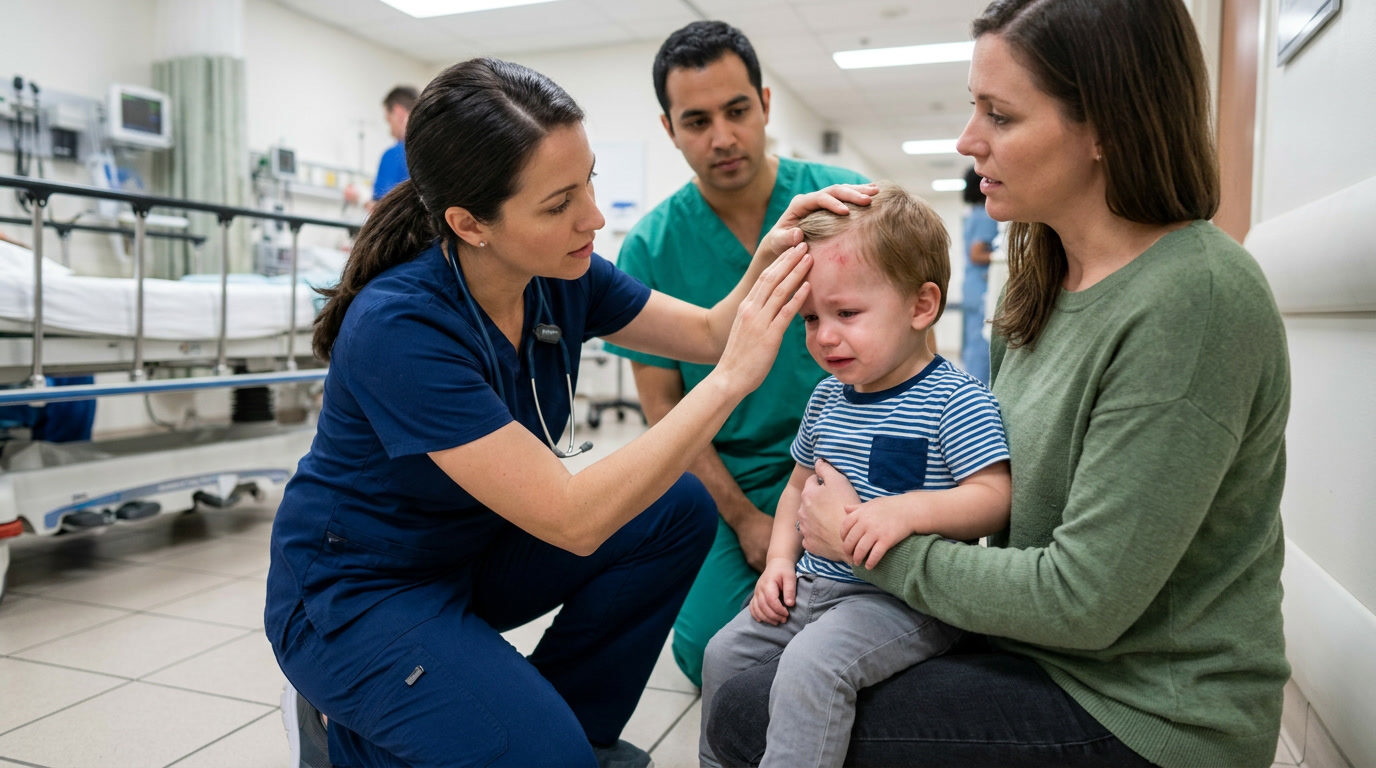
Falls are the leading cause of traumatic brain injury in children under five. According to the Centers for Disease Control and Prevention (CDC), falls account for more than half of all TBI-related emergency department visits in children aged 0–4. That number is not a reason to wrap your toddler in bubble wrap; it is a reason to know exactly what to watch for after any significant knock to the head.
In this article you will understand:
1. Why Toddler Heads Are Uniquely Vulnerable
The toddler skull is still growing, and that very growth process creates specific risks. A toddler's head makes up roughly 25 percent of their total body length, compared with about 12 percent in an adult. That disproportionately large, heavy head raises their centre of gravity, making falls forward and sideways far more likely during early walking and running. At the same time, the neck muscles are still developing and cannot absorb the whipping force of a sudden impact the way a stronger neck can.
Inside the skull, the developing brain is surrounded by relatively more cerebrospinal fluid than an adult brain, which means it has more room to move when the head is struck. This "slosh" effect can bruise brain tissue against the inner skull wall even when the outer impact looks minor.
Understanding how your child's body is built for exploration, as outlined in our overview of physical development from first steps to full sprints, helps explain why falls are so common at this stage and why vigilance matters.
Why mild injuries are not always trivial
Research published in the journal Pediatrics (2015, Anderson et al., Royal Children's Hospital Melbourne) found that even children diagnosed with mild traumatic brain injury showed measurable differences in processing speed and memory at three-month follow-up compared with uninjured controls. "Mild" in clinical language refers to the initial severity score, not the absence of consequences.
2. Red Flags vs. Normal Reactions After a Head Bump
Distinguishing a scary-looking-but-benign bump from a genuinely dangerous injury is the most important skill a parent can have in this situation. Here is a practical breakdown.
Signs that are usually benign
Red-flag symptoms: seek emergency care immediately
3. How Head Injuries Can Affect Toddler Development
The risk is not only in the acute phase. Even concussions that resolve clinically can leave subtle fingerprints on a developing brain.
Research from the American Academy of Pediatrics (AAP) notes that toddlers who sustain even moderate TBI are at elevated risk for later difficulties with:
- Language development: delayed vocabulary acquisition and sentence complexity - Attention regulation: shorter attention spans and increased impulsivity - Emotional behaviour: increased irritability, anxiety, and sleep disruption - Executive function: reduced planning and problem-solving capacity that becomes apparent only when academic demands increase around age five to seven
This is why a head injury is not simply a "now" problem. Understanding how cognitive development actually works at this stage explains precisely why disruption to the neural wiring process carries long-term significance.
4. Immediate Steps to Take After a Head Injury
Acting calmly and systematically in the first minutes protects your child and gives clinicians the best possible information.
Step-by-step for the first 30 minutes
1. Do not move your child if you suspect a neck or spinal injury (for example, if they fell from height and landed awkwardly). Call emergency services and wait. 2. Stay calm and get to their level. Your emotional tone directly regulates theirs. A parent who is visibly panicked raises a toddler's physiological stress response, which complicates assessment. 3. Check responsiveness. Speak their name and gently touch their hand. Note whether they respond normally, are confused, or do not respond. 4. Apply a cold cloth or ice pack (wrapped in a cloth) to a scalp swelling for 10–15 minutes. This reduces bleeding under the skin; it does not treat an internal injury. 5. Do not give ibuprofen or aspirin in the first 24 hours, as both can increase bleeding risk. Paracetamol (acetaminophen) at the correct toddler dose is acceptable if your child is clearly in pain and there are no red-flag symptoms. 6. Call your paediatrician or a nurse helpline (in the UK: NHS 111; in the US: your practice's after-hours line) for any fall from more than the child's own height, any head-first fall onto a hard surface, or any red-flag symptoms listed above. 7. Go directly to the emergency department for any of the red-flag symptoms in Section 2.
5. Long-Term Monitoring and When to Escalate
The first 24 hours are critical, but the following two weeks matter too.
What to watch in the days after injury
Follow-up visits
The AAP recommends a follow-up appointment with your paediatrician within 48–72 hours for any confirmed or suspected concussion. If symptoms persist beyond two weeks (a phenomenon called post-concussion syndrome), referral to a paediatric neurologist or neuropsychologist is appropriate.6. Prevention: Making Everyday Environments Safer
Prevention does not mean restricting movement; it means designing the environment intelligently and using appropriate protective equipment for higher-risk activities.
At home
At the playground
For sports and active play (older toddlers, ages 2–3)
For toddlers who are playing actively in group settings or beginning introductory sports classes, soft-shell headgear is available and appropriate for activities with fall or collision risk. The Holiberty Foam Padded Scrum Cap is a lightweight, breathable option suitable for young children, while the NICEYST Protective Headband offers a low-profile choice for active toddlers who resist bulkier gear.


Soft Shell Rugby 7v7 Football Helmet Foam Padded Scrum Cap Headgear Autism Safety Bump Hat Head Support Protector Adjustable Flag Football Soccer Goalie Helmet for Youth Kids Adults
- Excellent Head Protection: The protective pad is made of shock-absorbing and impact-resistant EVA foam, can ef
- Lightweight & Breathable: Made from premium quality polyester and high density foam, our helmet is extremely l
- Ergonomic Design: 3D ergonomic shape fits different head curves more closely, can wear firmly without moving;


Storelli ExoShield Head Guard, Military-Grade Head Protection, Foam Padding Headband, Official Headgear of US Club Soccer
- MILITARY GRADE PROTECTION: The Exoshield Head Guard is a highly rated ASTM Certified head protection for socce
- HELPS REDUCE IMPACT FORCES: Rated 5-stars by Helmet Lab, this head guard is estimated to help absorb and reduc
- COMFORTABLE & ERGONOMIC: This sleek yet heavy-duty head guard provides safety and comfort for players of all b
Head Protection Options: At-a-Glance Comparison
| Head Protection Type | Best Age / Activity | Key Benefit | Main Limitation | Recommended Product | Price Range |
|---|---|---|---|---|---|
| Foam scrum cap | Toddlers 18 months+, group play | Lightweight, breathable, autism-friendly sensory design | Not rated for high-impact sports | Holiberty Scrum Cap | $18 |
| Soft-shell headband | 2–3 yr, soccer, running | Minimal profile, adjustable, multi-sport | Limited coverage area | NICEYST Headband Guard | $10 |
| ASTM-certified soccer guard | 3 yr+, formal soccer classes | Military-grade foam, published impact data, ASTM certified | Overkill for casual backyard play | Storelli ExoShield Guard | $60 |
| Polymer-core headband | 3 yr+, contact sport intro | 50%+ impact force reduction (Intertek tested) | Fewer reviews, sizing key | ForceField FF Ultra PRO | $30 |
| Soft-shell helmet cover | 3 yr+, flag football / lacrosse | Fits over existing helmet, reduces "crack" impact | Requires a separate helmet | Guardian Cap Helmet Cover | $75 |
| Thin athletic cap | 3 yr+, light contact sport | Very low profile, barely noticeable | Minimal published impact data | 2nd Skull Sports Cap | $65 |
Expert Insights
Your toddler is supposed to fall. Falling is how they learn to run, climb, and test their extraordinary, rapidly wiring brain. Your job is not to prevent every tumble; it is to know the difference between a bump that needs a cuddle and one that needs a clinician. That knowledge, kept ready and calm, is the single most powerful protection you can give them.
The most shareable truth here: most head injuries in toddlers are minor, but the ones that aren't can look minor at first. Know the red flags. Trust your instincts. Act early.
If this article was useful, save it somewhere you can find it quickly, because the moment after a fall is exactly the wrong time to start searching. Share it with any caregiver who spends time with your child.
Sources & References
- Centers for Disease Control and Prevention. "Traumatic Brain Injury and Concussion: Children." 2023. https://www.cdc.gov/traumaticbraininjury/children.html
- American Academy of Pediatrics, Council on Injury, Violence and Poison Prevention. "Pediatric Head Trauma: Clinical Report." Pediatrics. 2023.
- Anderson V, et al. "Childhood Brain Insult: Can Age at Insult Help Us Predict Outcome?" Brain. Murdoch Children's Research Institute. 2012.
- Anderson VA, et al. "Cognitive and Behavioural Outcomes Following Early Childhood Head Injury." Pediatrics. 2015; 135(3).
- NICE (National Institute for Health and Care Excellence). "Head Injury: Assessment and Early Management." Clinical Guideline CG176. Updated 2023. https://www.nice.org.uk/guidance/cg176
- Royal College of Paediatrics and Child Health. "Management of Head Injury in Children." 2020. https://www.rcpch.ac.uk
- Zonfrillo MR, et al. "Pediatric Emergency Department Visits for Head Trauma." Pediatric Emergency Care. 2012; 28(6): 544–549.
- CDC HEADS UP programme. "Concussion in Youth Sports." 2023. https://www.cdc.gov/headsup
Frequently Asked Questions
My toddler bumped their head and cried, then seemed completely fine. Do I still need to see a doctor?
Is it safe to let my toddler sleep after hitting their head?
How do I know if my toddler has a concussion, not just a bruise?
Do toddlers fully recover from concussion?
What about the soft spot on my baby's head? Does it offer protection?
How can I make bath time and nappy changing safer to prevent falls?
Are some toddlers at higher risk for serious head injury than others?
Was this helpful?
Thanks — your feedback helps us pick what to write next.