The Science Behind Tummy Time: Why Position Is Everything
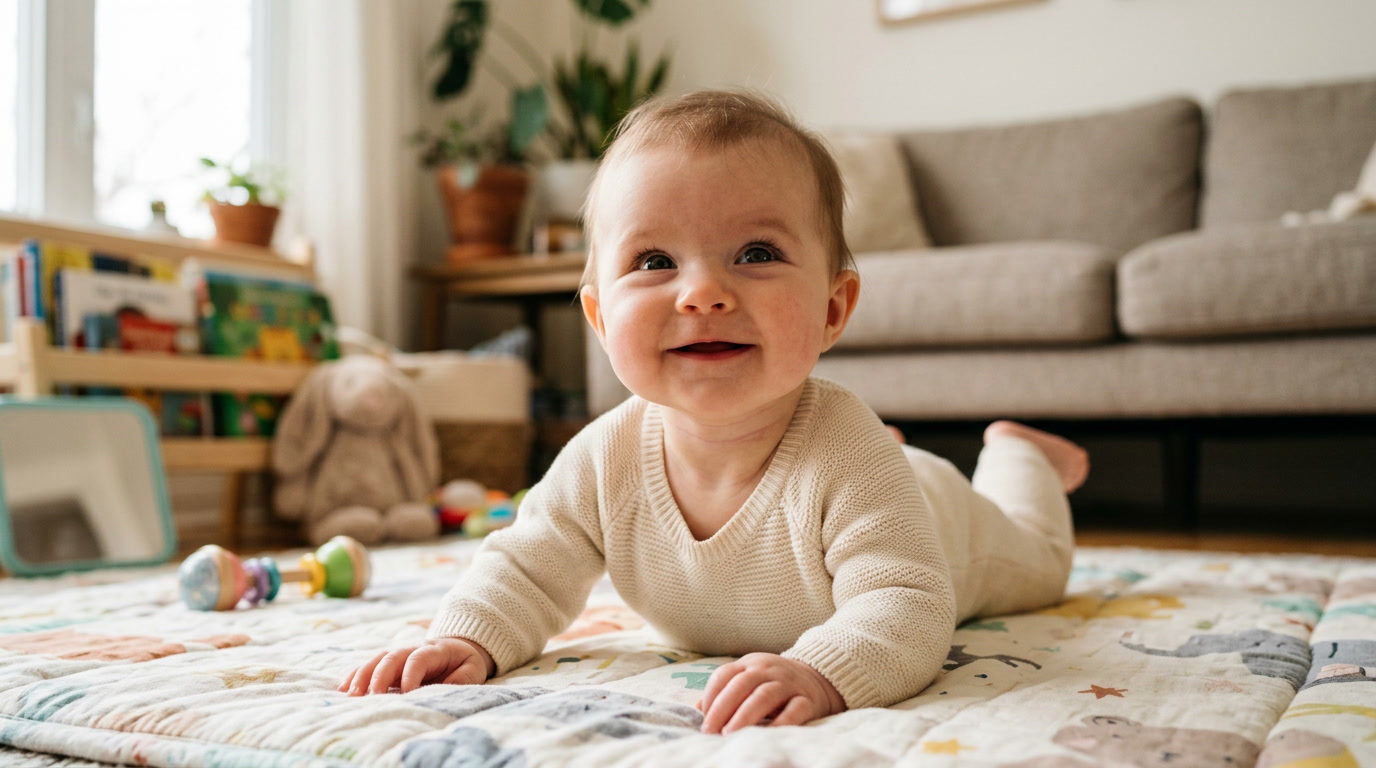
Tummy time is the single most effective daily habit you can build for your infant's physical and cognitive development — strengthening neck and core muscles, preventing flat head syndrome, and laying the neural groundwork for crawling, sitting, and beyond.

In this article
You're already doing the most important thing: putting your baby down safely on their back to sleep. But here's the part many parents miss — the American Academy of Pediatrics (AAP) recommends that awake, supervised tummy time should begin from day one, and that by 3–4 months, babies should be working toward a total of at least 30 minutes per day in the prone position. Research published in Pediatric Physical Therapy has found that infants who receive consistent tummy time reach motor milestones measurably earlier than those who don't. That's not a small detail. It's the difference between a baby who struggles to hold their head up at four months and one who's confidently pushing up on their arms.
This guide will walk you through exactly why tummy time matters, how it changes as your baby grows from 3 to 12 months, and how to make every session count.
What you'll understand after reading:
1. The Science Behind Tummy Time: Why Position Is Everything
Tummy time works because it forces your baby's developing nervous system to solve a genuinely hard problem: lifting and controlling a head that makes up roughly 25% of their total body weight, entirely against gravity.
When your baby is placed on their stomach, their brain must instantly coordinate input from three systems simultaneously — the visual system (what they can see), the vestibular system (the inner ear's balance sensors), and the proprioceptive system (the body's sense of its own position in space). This three-way integration is the foundation of motor planning and coordination — skills that underpin every milestone from rolling to walking.
What's Happening in the Brain
Each time your baby lifts their head during tummy time, new synaptic connections form between the motor cortex, cerebellum, and brainstem. The cerebellum — which governs balance, coordination, and fine motor control — is particularly active during prone play. Neurologically, these sessions are doing heavy lifting long before your baby's muscles are strong enough to show it.
The AAP notes that the back-to-sleep, tummy-to-play approach — introduced following the 1994 "Back to Sleep" campaign — dramatically reduced SIDS deaths but also created a generation of infants with less daily prone time. That's why intentional, supervised tummy time became a formal recommendation: the developmental benefits don't happen automatically anymore.
2. Building Neck, Shoulder, and Core Strength — The Milestone Foundation
Every major motor milestone your infant will hit between 3 and 12 months depends on a chain of muscle groups that tummy time directly targets: the neck extensors, shoulder stabilisers, and deep core muscles.
Here's how that chain works in practice:
- Head control (3–4 months): The sternocleidomastoid and upper trapezius muscles strengthen enough to hold the head steady at 45–90 degrees - Pushing up on forearms (4–5 months): Shoulder girdle and scapular stabilisers engage, building the base for rolling - Extended arm push-ups (5–6 months): Triceps and wrist extensors develop, preparing the upper body for crawling - Pivoting and reaching (6–8 months): Core rotation and hip flexor strength emerge, enabling directional movement
Prone positioning provides the mechanical loading necessary for the development of postural control. Without adequate tummy time, infants may show delays in head control and upper extremity weight-bearing that cascade into later gross motor delays.
— American Academy of Pediatrics, *Pediatric Physical Therapy* guidelines (2022)
Why This Matters Beyond Crawling
Parents sometimes hear that crawling is optional — that some babies skip straight to walking — and assume tummy time is therefore optional too. It isn't. Even babies who skip crawling still need the neck stability, shoulder strength, and core control that tummy time builds. These muscles support upright sitting, which precedes walking regardless of whether crawling happens.


Baby Einstein 4-in-1 Kickin' Tunes Music and Language Play Gym and Piano Tummy Time Activity Mat
- The best-selling Baby Einstein 4-in-1 Kickin’ Tunes Music & Language Discovery Activity Gym supports fine and
- 4 modes include lay and play, sitting up, tummy time, on the go; Helps baby strengthen neck muscles during tum
- 7 sensory toys engage and promote fine and gross motor skills like reaching, pressing, and kicking; crinkle me
A structured activity mat like the Baby Einstein 4-in-1 Kickin' Tunes Play Gym supports tummy time with a built-in pillow that gently props your baby's chest, reducing the effort needed to lift their head in early sessions — a smart bridge for babies who protest the flat floor.
3. Motor Skill Development: The Road From Rolling to Crawling
Tummy time doesn't just strengthen muscles in isolation — it teaches your baby the movement patterns that become rolling, sitting, and crawling.
Between 3 and 6 months, you'll notice your baby starting to rock side to side during tummy time. That's not random wiggling. It's the beginning of weight-shifting — the same motor pattern that will eventually produce a roll. When your baby reaches for a toy during prone play, they're practising the lateral weight transfer that rolling requires.
The Rolling Connection (4–6 Months)
Rolling from tummy to back typically appears first, around 4 months, because it's the path of least resistance — gravity helps. Rolling from back to tummy follows around 5–6 months, requiring significantly more core strength and rotational control. Both are seeded directly by tummy time.
The Crawling Connection (7–10 Months)
Crawling requires your baby to simultaneously bear weight through their arms, maintain a neutral spine, and alternate limb movements in a coordinated pattern. Every one of those components is rehearsed during tummy time — arms pushing up, spine extending, legs beginning to push against the floor.
Place a Poycuna High Contrast Baby Gym Mat just out of your baby's reach during tummy time from around 4 months onward. The motivation to reach for the high-contrast images and dangling toys naturally encourages the weight-shifting and reaching that precede crawling.



Poycuna Black and White Baby Gym Play Mat with 6 Toys Tummy Time Activity Mat for Babies 0-6 6-12 Months High Contrast Baby Gyms & Playmats Sensory Toys Newborn Brain Development Infant Play Mat
- 【Attractive High Contrast Baby Play Gym】A newborn’s vision takes several months to develop fully. The baby pla
- 【All-Round Early Development】Surprise: The red cherries are hidden under the ladybird wings. Our baby tummy ti
- 【Attract Baby's Attention】The contrast gym mat and cute toys help babies to develop their ability to focus the
4. Brain Development and Sensory Processing: The Cognitive Case for Prone Play
Tummy time is as much about brain development as it is about muscles — and this is the part most parenting guides underemphasise.
When your baby is on their tummy, they experience the world from a fundamentally different vantage point. Their visual field shifts. The floor feels different under their palms. Gravity pulls differently on every part of their body. This novel sensory environment is exactly what a developing brain needs to build rich, complex neural maps.
Vestibular and Proprioceptive Stimulation
The vestibular system — housed in the inner ear — detects head position and movement. During tummy time, every head lift and turn sends a stream of vestibular data to the brainstem and cerebellum. Over weeks and months, this input builds the postural reflexes that allow your baby to sit without toppling, reach without falling, and eventually walk without thinking about balance at all.
Proprioception — the body's internal GPS — is simultaneously activated as muscles, tendons, and joints report their positions to the brain. The combination of vestibular and proprioceptive input during prone play is one of the richest forms of sensory integration available to an infant.
Visual-Motor Coordination
When your baby lifts their head to look at a toy, they're training their eyes and hands to work together — a skill called visual-motor integration that underpins later abilities including hand-eye coordination, spatial reasoning, and eventually reading and writing.
High-contrast patterns are particularly valuable here. A newborn's visual acuity is limited to roughly 20–40cm, and high-contrast black-and-white images are the easiest for immature visual systems to process. By 3–4 months, colour vision has developed enough to engage with bolder hues.
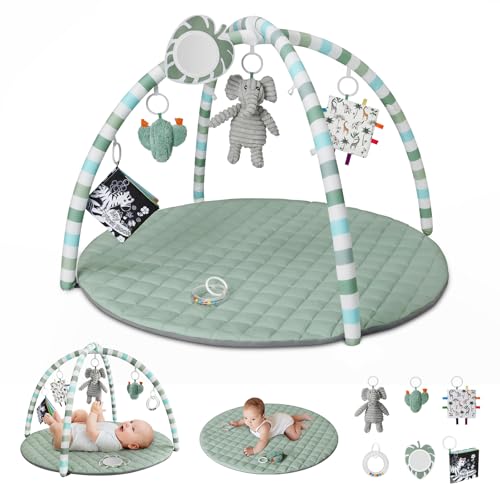
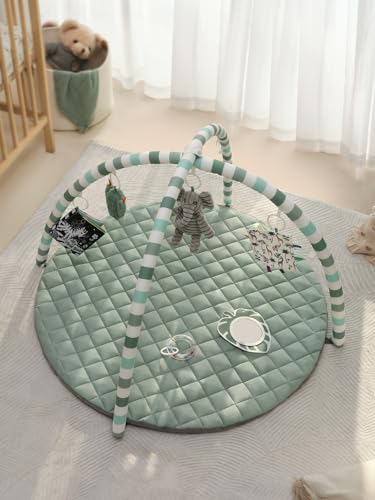
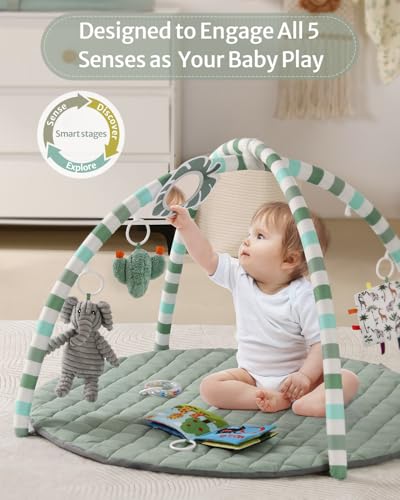
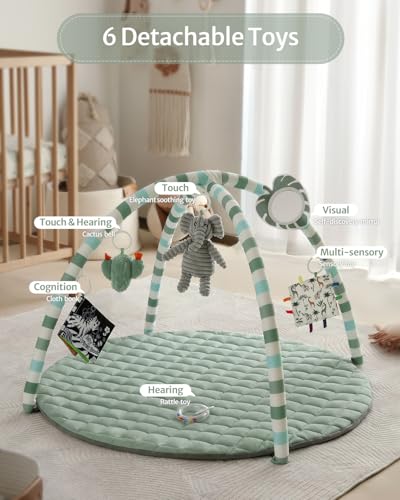
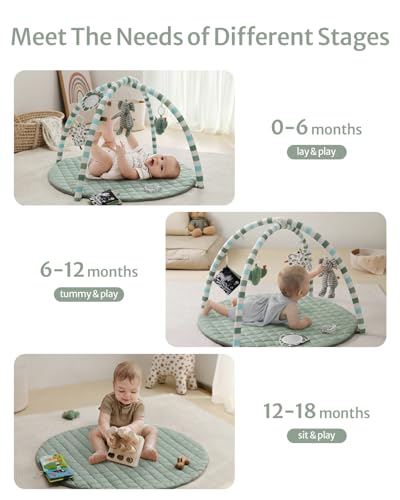
Blissful Diary Baby Play Gym Mat, Play Mat Activity Mat with 6 Detachable Toys for Stage-Based Sensory & Motor Skill Development, Easy to Install & Clean, Baby Essentials Gift, Sage Green
- Newborn Baby Essentials - The baby play gym is designed to develop stage-based sensory and motor skill. The so
- All-Round Early Development - The activity gym has 6 detachable toys which fully engage 5 senses as your baby
- Easy to Assemble & Take Down - The tummy time activity mat's size is 33.46x33.46 inch, crafted using ethically
The Blissful Diary Baby Play Gym Mat (Sage Green) includes a self-discovery mirror and high-contrast visual elements specifically designed to support this visual-motor development during prone play — making it an excellent choice from 3 months onward.
5. Preventing Flat Head Syndrome (Positional Plagiocephaly)
Positional plagiocephaly — the flattening of one area of the skull from sustained pressure — affects between 20% and 46% of healthy infants, according to research published in the Journal of Craniofacial Surgery. It became significantly more common after the 1994 Back to Sleep campaign, because infants now spend more cumulative time on their backs.
The good news: consistent tummy time is the most effective preventive measure available, and it costs nothing.
Why It Happens — and How Tummy Time Helps
An infant's skull bones are not yet fused. They remain soft and malleable for the first several months of life — which is biologically brilliant for birth, but means that sustained pressure in one spot can cause measurable flattening. Babies who spend long periods with their head turned to the same side (often because of tight neck muscles, a condition called torticollis) are at highest risk.
Tummy time addresses plagiocephaly in two ways:
The best prevention for positional plagiocephaly is supervised tummy time when the infant is awake and alert, combined with repositioning techniques during sleep.
— Canadian Paediatric Society, *Positional Plagiocephaly* position statement (2021)
6. Age-Appropriate Tummy Time Strategies: 3 to 12 Months
Tummy time looks very different at 3 months than it does at 9 months — and matching the activity to your baby's current developmental stage makes every session more effective and more enjoyable.
3–4 Months: Building Tolerance and Head Control
At this stage, your baby can likely lift their head to about 45 degrees and hold it briefly. Sessions of 3–5 minutes, three to five times daily, are the target. Many babies still protest, so keep sessions short and immediately rewarding.
The UMIKU Dinosaur Baby Gym Play Mat works well at this stage — its piano music and bright hanging rattles give babies an immediate auditory and visual reward for lifting their heads.
5–6 Months: Extended Arms and Reaching
Your baby can now push up onto extended arms, lifting their chest clear of the floor. This is the stage to introduce toys just out of reach to encourage pivoting and lateral weight-shifting.


Baby Gym Play Mat, 8-in-1 Tummy Time Mat & Activity Gym, Washable Ball Pit, Infant Play Mat with Detachable Toys for Sensory Exploration and Motor Skill Development
- [8-in-1 Baby Activity Play Mat]: Designed for newborns and infants 0-6-12 months, our animal-themed 8-in-1 bab
- [Safe and Easy to Clean]: This baby play mat is made of polyester and cotton and has been tested to be phthala
- [Foldable Surround Fence]: This foldable play mat is highly practical-simply fold up the sides to create a pro
The TFDER 8-in-1 Tummy Time Mat & Activity Gym is particularly useful at this stage — its foldable surround fence keeps toys within the play space while the giraffe, tree, and elephant sensory toys with sound effects give your baby multiple targets to reach toward.
7–12 Months: Pre-Crawling and Beyond
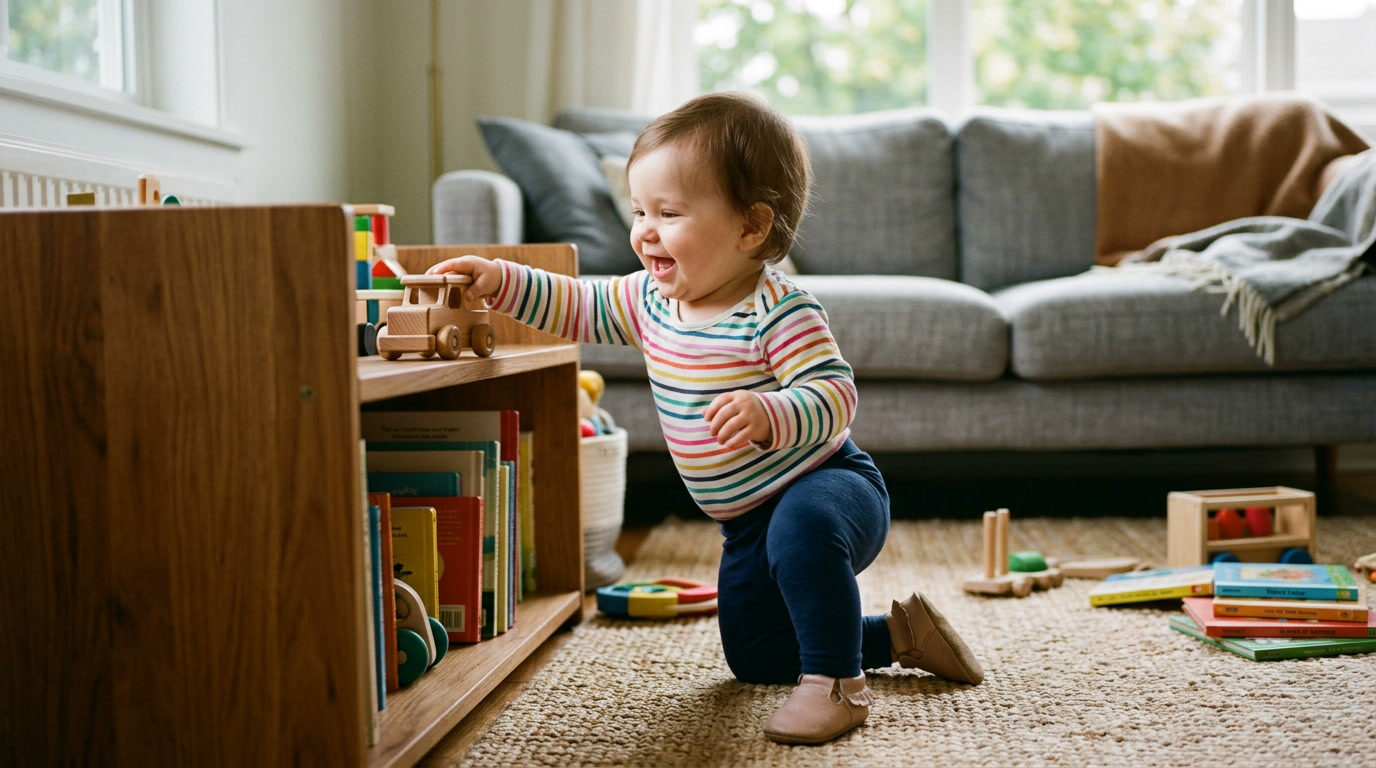
By 7 months, many babies are rocking on hands and knees during tummy time — the precursor to crawling. At this stage, tummy time merges naturally into floor play. Your job shifts from encouraging the position to enriching the environment.
The Blissful Diary Baby Play Gym Mat (Sandy Beige) transitions beautifully across this age range, with detachable toys that can be repositioned to keep sessions fresh as your baby's abilities develop.
Age-Based Tummy Time Comparison
| Age Stage | Daily Goal | Key Skill Being Built | Best Setup | Recommended Product | Price Range |
|---|---|---|---|---|---|
| 0–3 months | 10–15 min (split into short sessions) | Head control, neck extension | Chest-to-chest, rolled towel support | UMIKU Dinosaur Baby Gym Mat | ~$30 |
| 3–5 months | 20–30 min total | Forearm push-up, visual tracking | Firm mat with high-contrast visuals | Poycuna High Contrast Baby Gym | ~$38 |
| 5–7 months | 30+ min total | Extended arm push-up, reaching, pivoting | Mat with toys placed in semicircle | Baby Einstein 4-in-1 Play Gym | ~$50 |
| 7–10 months | Integrated into floor play | Rocking on hands and knees, crawling prep | Open floor space with obstacle variation | TFDER 8-in-1 Tummy Time Gym | ~$40 |
| 10–12 months | Ongoing floor play | Core stability for standing, cruising | Mixed surface textures, pull-up furniture nearby | Blissful Diary Play Gym (Sage Green) | ~$36 |
Expert Insights
Conclusion
Those few minutes on the floor each day are doing far more than they appear. Every time your baby strains to lift their head, reaches for a toy, or pushes up onto their arms, they're building the physical strength and neural architecture that will carry them through the first year and beyond. Tummy time is not a chore to get through — it's some of the most productive developmental work your baby will do all day.
The simplest truth in infant development is this: the floor is where babies grow. Get down there with them, make it playful, and trust that the effort — yours and theirs — is adding up in ways you'll see clearly at every milestone check.
If this guide was useful, save it for a sleep-deprived moment when you need the reminder, and share it with another parent who's wondering why their baby is fussing face-down on the mat.
Sources & References
- American Academy of Pediatrics. "Back to Sleep, Tummy to Play." HealthyChildren.org. 2022. https://www.healthychildren.org/English/ages-stages/baby/sleep/Pages/back-to-sleep-tummy-to-play.aspx
- Canadian Paediatric Society. "Positional Plagiocephaly: Prevention, Assessment and Referral." Paediatrics & Child Health. 2021. https://cps.ca/en/documents/position/positional-plagiocephaly
- Jennings, J.T., Sarbaugh, B.G., & Payne, N.S. "Conveying the Message About Optimal Infant Positions." Physical & Occupational Therapy in Pediatrics. 2005.
- Kuo, Y.L., et al. "Trunk, Neck, and Cephalic Positions During Prone and Supine Positions in Healthy Infants." Pediatric Physical Therapy. 2008.
- Mawji, A., et al. "The Incidence of Positional Plagiocephaly: A Cohort Study." Pediatrics. 2013. American Academy of Pediatrics.
- Dudek-Shriber, L., & Zelazny, S. "The Effects of Prone Positioning on the Quality and Acquisition of Developmental Milestones in Four-Month-Old Infants." Pediatric Physical Therapy. 2007.
- World Health Organization. "WHO Motor Development Study: Windows of Achievement for Six Gross Motor Development Milestones." Acta Paediatrica Supplement. 2006.
- Royal College of Paediatrics and Child Health (RCPCH). "Personal Child Health Record (Red Book) — Developmental Milestones." 2023. https://www.rcpch.ac.uk
Frequently Asked Questions
How much tummy time does a 3-month-old need?
My baby cries every time I put them on their tummy. What should I do?
Can I do tummy time after feeding?
Does tummy time on my chest count?
When can I stop doing structured tummy time?
Can tummy time help with reflux?
What if my baby skips crawling — did tummy time still matter?
Was this helpful?
Thanks — your feedback helps us pick what to write next.